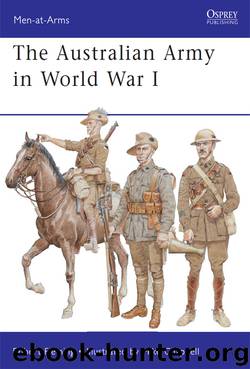
The Australian Army in World War I by Robert Fleming
Author:Robert Fleming
Language: eng
Format: epub
Tags: The Australian Army in World War I
ISBN: 9781780964577
Publisher: Osprey Publishing Ltd
Published: 2012-04-24T16:00:00+00:00
A surgeon captain attending a wounded man in an Australian Advanced Dressing Station during the fighting at Hill 60, Ypres, on 26 August 1917. Heavy Australian casualties led to referenda over the introduction of conscription, on 28 October 1916 under the Military Service Referendum Act 1916, and on 20 December 1917 under the War Precautions (Military Service Referendum) Regulations 1917, but on both occasions the Australian electorate rejected the proposal. Serving soldiers had a voice in this decision alongside the voters at home. (Australian War Memorial)
On 7 June 1917, II ANZAC Corps joined the British IX and X Corps to launch an attack near Messines, south of the Ypres Salient in Flanders. In preparation for the attack British, Canadian, Australian and New Zealand engineers had constructed an elaborate tunnel system under the German lines, digging 22 mines in which they placed over 440 tons (450,000kg) of explosives. An artillery barrage preceded detonation, tricking the Germans into expecting an infantry assault, and as soon as it lifted they rushed back to their defensive positions. The mines were detonated at 3.10am, and although three failed to go off, some 10,000 German soldiers were killed in the destruction of their defences (and of most of the town of Messines as well).
The Australian 3rd Div faced heavy counter-shelling while forming up, including the use of phosgene gas, but still took part in the attack. A second intense Allied barrage followed immediately after the detonation of the mines, this time a ‘creeping barrage’ that lifted and moved forward progressively in front of the advancing infantry. The men from II ANZAC Corps and British IX and X Corps attacking the Messines salient from three sides faced relatively brief opposition, with many Germans surrendering in confusion. The German front lines were taken in just 3 hours, all objectives were secured within 12 hours, and a counter-attack was easily repulsed. Nevertheless, II ANZAC Corps still suffered 6,800 casualties during the battle of Messines.
The major British offensive in late summer 1917 was intended to take pressure off the war-weary French Army, which was disrupted by mutinies following the catastrophic failure of the Chemin des Dames offensive. Field Marshal Haig’s objective was to push eastwards out of the Ypres Salient to capture Passchendaele Ridge, which might then allow the recapture of the entire Belgian coast as far as the Dutch border. The main thrusts were to be made using ‘bite and hold’ tactics, with each successive objective limited to what could be held against a counter-attack.
British Fifth Army commenced their attack on 31 July 1917 along a 15-mile (25km) front. In 15 days the Allied batteries, including Australian artillery, had fired more than 4 million shells, but the Germans had prepared their defences in depth. The front lines were protected by strong concrete pillboxes, and the infantry could sit out the barrages in deep shelters. Their barbed wire entanglements were designed to funnel advancing attackers towards enfilading machine guns, and German artillery was well positioned to cover any attacks. The
Download
This site does not store any files on its server. We only index and link to content provided by other sites. Please contact the content providers to delete copyright contents if any and email us, we'll remove relevant links or contents immediately.
| Africa | Americas |
| Arctic & Antarctica | Asia |
| Australia & Oceania | Europe |
| Middle East | Russia |
| United States | World |
| Ancient Civilizations | Military |
| Historical Study & Educational Resources |
The Radium Girls by Kate Moore(12035)
100 Deadly Skills by Clint Emerson(4931)
Rise and Kill First by Ronen Bergman(4797)
The Templars by Dan Jones(4692)
The Doomsday Machine by Daniel Ellsberg(4493)
The Rape of Nanking by Iris Chang(4222)
Killing England by Bill O'Reilly(4008)
Stalin by Stephen Kotkin(3973)
Hitler in Los Angeles by Steven J. Ross(3948)
12 Strong by Doug Stanton(3554)
Hitler's Monsters by Eric Kurlander(3347)
Blood and Sand by Alex Von Tunzelmann(3207)
The Code Book by Simon Singh(3197)
Darkest Hour by Anthony McCarten(3135)
The Art of War Visualized by Jessica Hagy(3013)
Hitler's Flying Saucers: A Guide to German Flying Discs of the Second World War by Stevens Henry(2758)
Babylon's Ark by Lawrence Anthony(2685)
The Second World Wars by Victor Davis Hanson(2529)
Tobruk by Peter Fitzsimons(2521)
